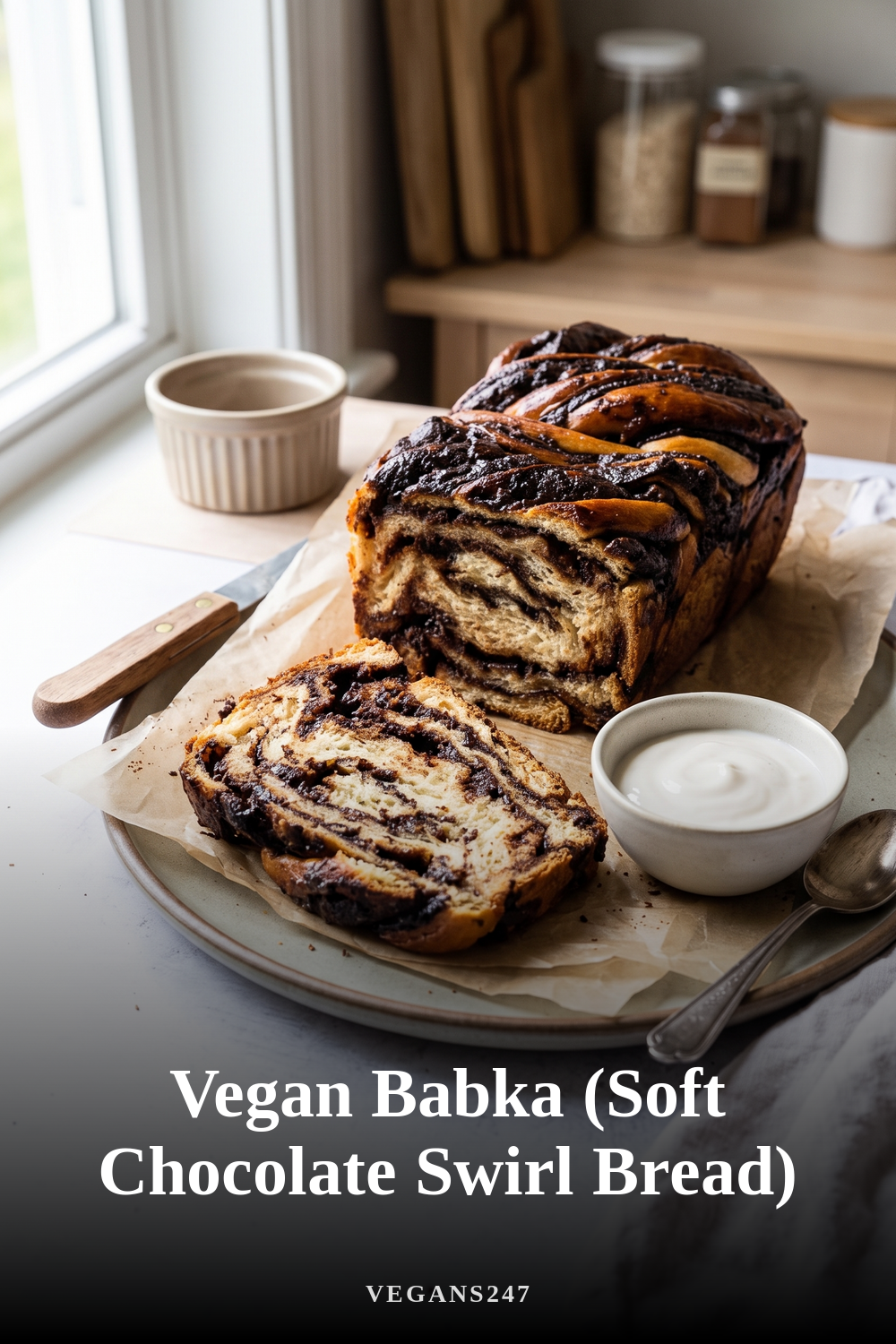
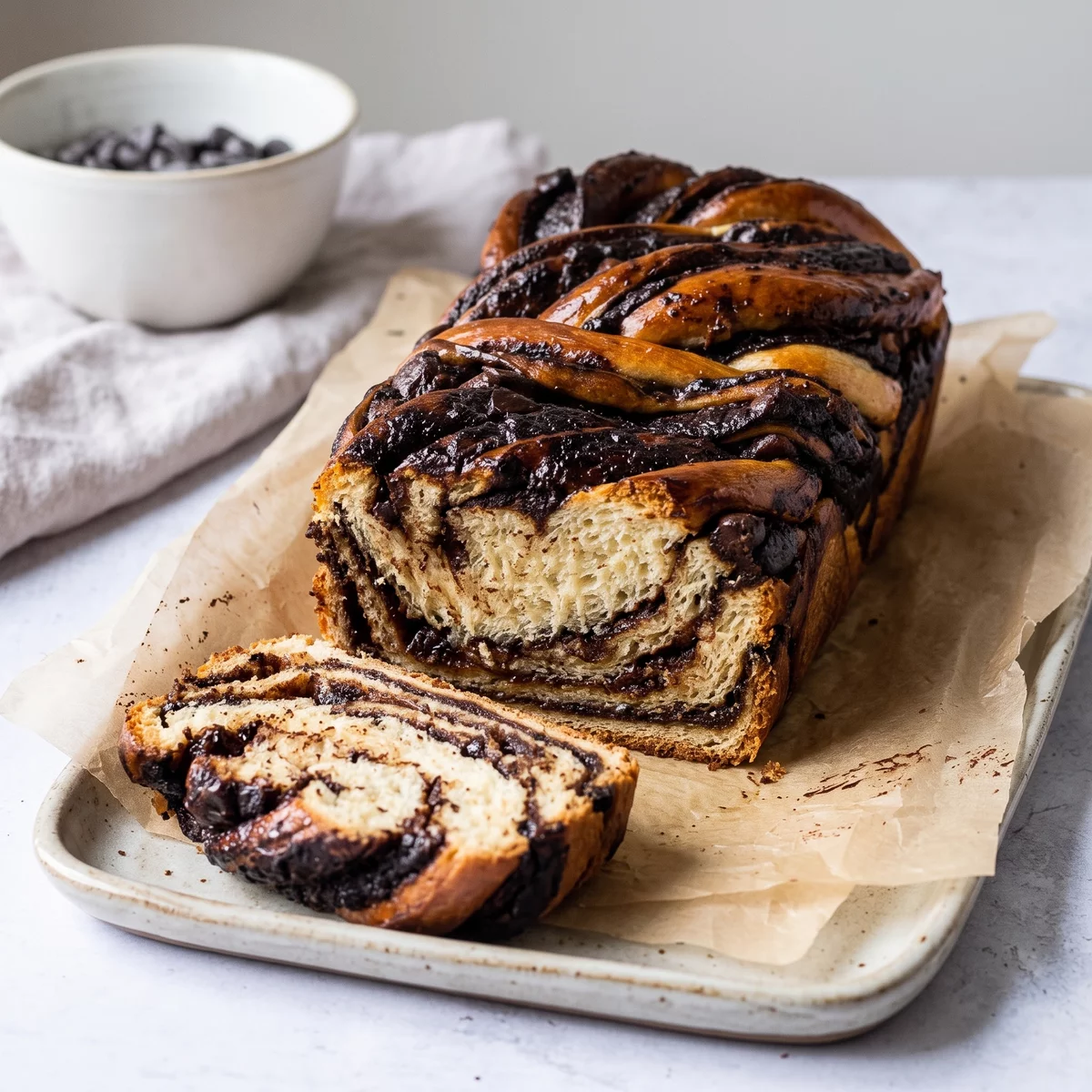
This vegan babka is built around a two-stage cold proof. I mix a soft, enriched dough, let it rise for an hour on the counter, then move it to the fridge overnight so the fat firms up and the flavor deepens. Cold dough rolls out cleanly and holds a tight spiral, which is what keeps the chocolate swirl sharp instead of smeared across the loaf.
Babka is a sweet, cake-like yeast bread, and making it vegan takes a little care because there are no eggs to lean on for structure. I use unsweetened plant yogurt for body and knead vegan butter in late, once the dough is already smooth, so it turns silky rather than greasy. The filling is a thick chocolate paste rather than a thin sauce, and a brush of sugar syrup after baking keeps the crust soft. The dough rhythm is close to my vegan cinnamon rolls, just shaped into a twist instead of a coil.
Vegan Babka
Ingredients
Method
- Whisk the bread flour, sugar, yeast, and salt together in a large bowl or the bowl of a stand mixer. Add the lukewarm oat milk, vegan yogurt, and vanilla, then mix to form a rough, shaggy dough.
- Knead on medium speed, or by hand on a lightly floured surface, for about 5 minutes until the dough comes together into a soft ball. Add the softened vegan butter a spoonful at a time and keep kneading for another 8 to 10 minutes, until the dough is smooth, elastic, and pulls away from the sides of the bowl.
- Cover the bowl and let the dough rise at room temperature for 1 hour, until it has grown noticeably. Then move it to the fridge and let it cold-proof overnight, 8 to 12 hours, until doubled.
- Make the filling while the dough is out. Melt the chopped vegan dark chocolate, vegan butter, cocoa powder, brown sugar, cinnamon, and salt together in a small pan over low heat, stirring until smooth. Take it off the heat and let it cool for about 20 minutes, until it is thick but still spreadable.
- Punch down the chilled dough and roll it on a lightly floured surface into a rectangle about 12 by 16 inches (30 by 40 cm). Spread the cooled filling over the dough, leaving a 1-inch border on all sides, then scatter over the vegan chocolate chips and press them in gently.
- Roll the dough up tightly from one long edge into a log. Place the log seam-side down on a tray and chill it in the fridge for 15 to 20 minutes so the filling sets before you cut it.
- Use a sharp knife to cut the chilled log in half lengthwise, exposing the swirl. Turn the two halves cut-side up and twist them over each other into a loose braid, pinching the ends together. Lift the braid into a greased 9 by 5 inch loaf pan.
- Cover the pan and let the babka proof at room temperature for 1 1/2 to 2 hours, until it looks puffy and has risen to near the top of the pan.
- Heat the oven to 350F (175C). Bake the babka for 40 to 50 minutes, until the top is deep golden and an instant-read thermometer inserted into the center reads 195F (90C).
- While the babka bakes, simmer the sugar and water in a small pan until the sugar dissolves, then set the syrup aside. Brush the hot loaf generously with the syrup as soon as it comes out of the oven. Cool it in the pan for 15 to 20 minutes, then turn it out onto a rack and let it cool completely before slicing.
Notes
Tips for Vegan Babka
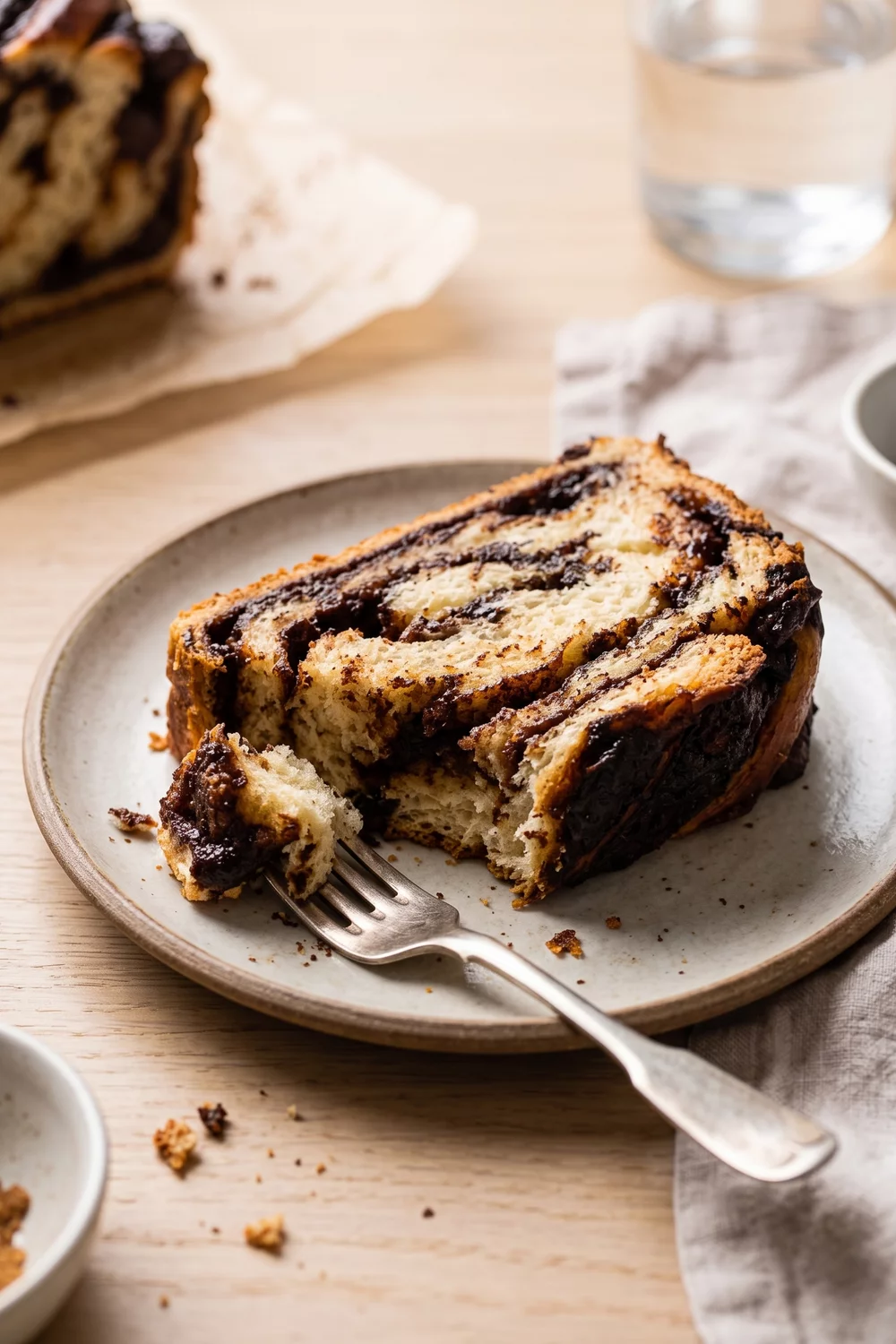
Babka looks fussy, but it mostly rewards patience rather than skill. A handful of small moves decide whether you get clean swirls or a chocolatey mess, and none of them take any extra time once the dough is made.
- Cold-proof the dough overnight. A warm, fast rise leaves the dough slack and sticky, while a night in the fridge firms the fat so the layers roll and twist cleanly.
- Chill the filled, rolled log for 15 to 20 minutes before you cut it lengthwise. Warm filling smears under the knife, and a cold log gives you two neat strands to braid. Any longer than 20 minutes and the dough gets too stiff to twist without cracking.
- Leave a one-inch border of bare dough all the way around the filling. Chocolate pushes outward as you roll and twist, and the border gives it somewhere to go instead of onto the counter. Trim the edges and reroll the scraps if your rectangle looks uneven.
- Cool the filling until it is thick and spreadable, not hot. If it is still warm it soaks straight into the dough and the swirl all but disappears in the oven.
- Bake to temperature rather than to color. An instant-read thermometer should read 195F (90C) in the center, the same doneness check I use for my vegan banana bread. The top browns well before the middle sets, and pulling it early leaves a gummy core.
- Brushing the hot loaf with sugar syrup is not just for shine. It keeps the crust soft and the inside moist, which is why a slice still tastes fresh on day three. Use a bar of chocolate you would eat on its own, the way you would for my vegan chocolate chip cookies.
Storage
Vegan babka is at its best on the day it is baked, but the syrup keeps it soft for 2 to 3 days. Wrap it tightly or keep it in a bread bin at room temperature, and leave it out of the fridge, which actually makes the crumb go stale faster. For longer storage, freeze slices in a zip-top bag for up to three months and warm them in a 300F oven for a few minutes to bring the crust back. Tuck a square of parchment between the slices first so they don’t fuse into one block. It holds up much like my vegan carrot cake: fine for a couple of days on the counter, and better than you would expect from the freezer.
FAQ
Why is my vegan babka dough so sticky?
Enriched doughs always start out sticky because of the fat and the liquid from the plant yogurt. Resist the urge to dump in extra flour; knead a few minutes longer and give the dough its cold rest, and it firms up on its own. A bench scraper helps here, since it keeps your hands out of the dough while you fold it over itself a few times. If it is still unworkable after chilling, knead in a tablespoon of flour at a time.
Can I make vegan babka without vegan butter?
Yes, though the crumb changes. A solid coconut oil or a mild olive oil works in both the dough and the filling, but the loaf ends up a little less rich and cake-like. If you use coconut oil, keep it soft and scoopable so it blends the way butter does, and use slightly less than the recipe calls for, since oil is all fat while vegan butter carries a little water.
Do I have to proof the dough overnight?
You can bake it the same day, but the overnight cold proof is what makes the dough easy to roll and gives the bread a deeper flavor. A same-day version needs a warm rise of 1 1/2 to 2 hours, and the dough will feel softer and harder to braid. Cold dough is also far easier to cut and twist, so the overnight rest is doing two jobs at once.
What chocolate should I use for the filling?
Use a vegan dark chocolate you would happily eat on its own, and check the label for milk fat or milk solids, since some bars include them. A bar around 60 to 70 percent cocoa melts into a filling that is rich without turning bitter, and vegan chocolate chips stirred in add pockets of texture. If you are not sure about a bar, melt a small piece first, let it cool, and taste it before committing it to the whole filling.